
Certified by 
If you are in a shipowner or ship management team, you already know the story.
On paper, software always looks great.
There are flashy feature lists, slick dashboards, promises of reports and automation, endless integrations, and the feeling that every operational problem will finally be solved.
Then the software goes live.
And the real test starts.
Does the crew actually want to use it, or does it just gather dust?
Does the office get the visibility it needs, or are you still wrestling with spreadsheets?
Are the departments working together, or stuck in their own silos?
Did you stick to your budget, or did the costs start to grow after implementation?
Or did you just end up with software that looks nice in a meeting but falls flat in real life?
This is not only a maritime issue.
Many industries face the same challenge: software is purchased based on features, but value depends on daily adoption. Pendo’s feature adoption research found that 80% of software features are rarely or never used. Gartner also predicts that by 2027, more than 70% of recently implemented ERP initiatives will fail to fully meet their original business goals.
For shipowners and ship managers, this matters even more.
A ship management system is not just another office tool. It affects maintenance, procurement, stock control, crew management, safety, compliance, budgeting, vessel communication, and management visibility.
So when choosing Ship Management Software, the question should not be:
“Who has the longest feature list?”
The better question is:
“Which system will our people actually use every single day?”
That is the approach behind WAYL.
The real goal is not software installation. It is daily adoption.
Many ship management software projects fail not because the software does not exist, but because the implementation does not become part of the company’s real working process.
The crew may not feel comfortable using it. The office may not receive the visibility they expected. Departments may continue working separately. Managers may still rely on spreadsheets, emails, or manual follow-ups.
And over time, the company ends up paying for a system that is technically available, but not fully adopted.
That is why usability, onboarding, data import, training, support, and pricing transparency are just as important as the modules themselves.
WAYL is built as a modular ship management software platform covering PMS, Stock, Purchase, Budget, Safety & Quality, Crew, Fleet, Ecology, Analytics, and Help, allowing companies to choose the modules that fit their actual operational needs.
When evaluating maritime software, it is easy to focus only on functions.
But a strong ship management system should answer deeper operational questions.
These questions decide whether software becomes useful or becomes another unused platform.
At WAYL, we believe ship management software should not create more complexity.
It should reduce it.
That is why the system is designed around practical maritime use, simple navigation, connected modules, and full onboarding support.
WAYL provides a simple interface for crew and office users, helping reduce errors, downtime, and inefficiencies. It is also designed to adapt to company processes, with customization and integration support included as part of the implementation approach.
The goal is not to force every company into a rigid system.
The goal is to help shipowners and managers build a setup that works for their fleet, their departments, and their daily routines.
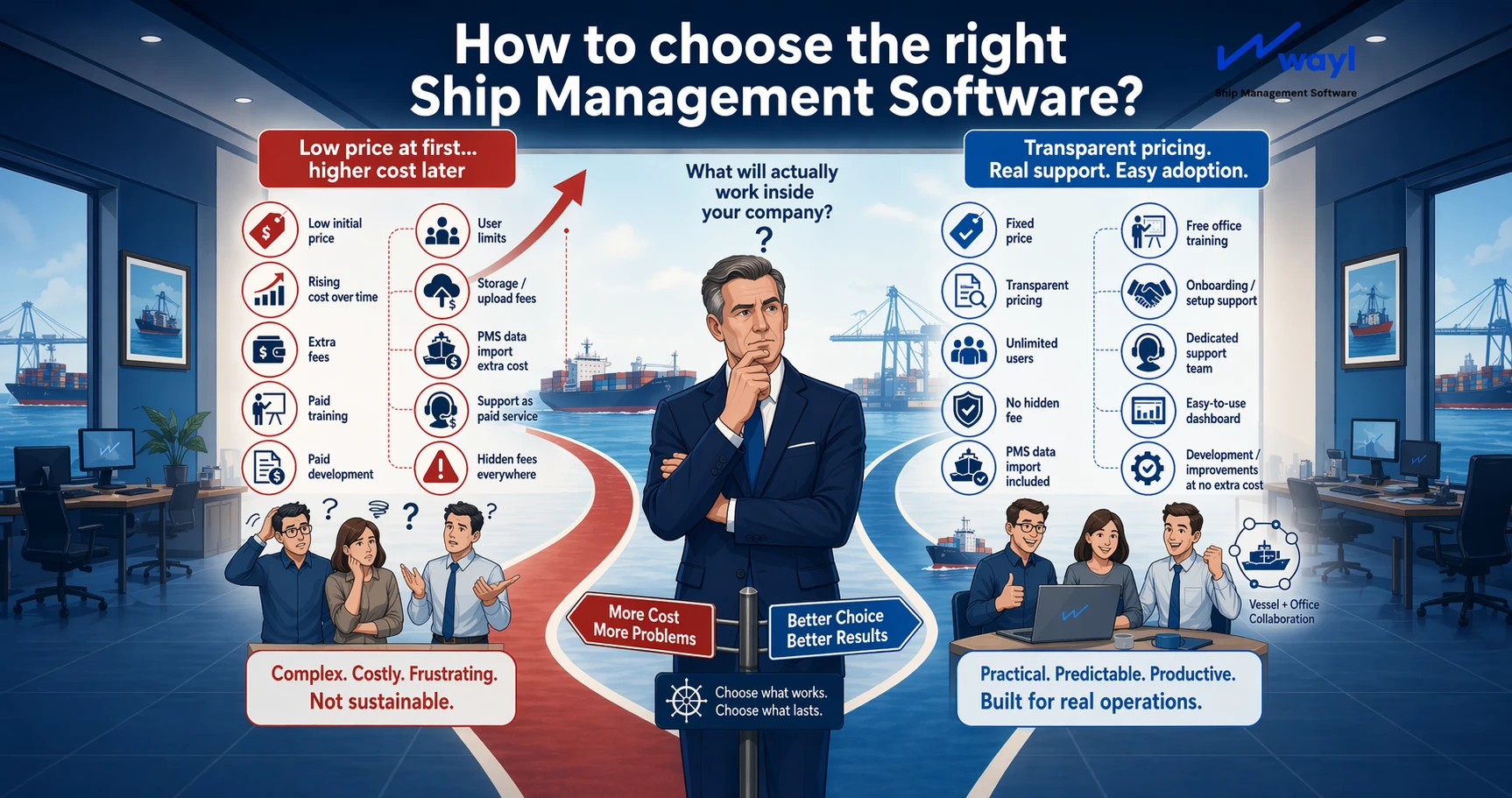
One of the biggest frustrations in software implementation is discovering hidden costs after the decision has already been made.
These are not small details. They directly affect the total cost of ownership.
With WAYL, the approach is clear:
If a new feature makes sense and brings value to the software, it can be developed at no extra charge.
WAYL’s Help Module also supports users with step-by-step guidance, visual information, printable guides, and online/offline access, helping both office and vessel users work more independently.
For Planned Maintenance System implementation, data is everything.
Even the best platform will not deliver value if the PMS data is incomplete, badly structured, or difficult to use.
Maintenance jobs, intervals, components, critical equipment, archives, and task structures must be prepared properly from the start.
WAYL’s PMS module supports technical scheduling, automated notifications, critical equipment management, archives, inventory integration, postponement requests, and task duplication.
But the system only becomes truly useful when the data inside it is reliable.
That is why PMS data import is included in the one-time license price.
For shipowners and managers, this is important because PMS setup is often one of the most time-consuming and sensitive parts of implementation.
Software implementation is not finished when the login details are sent.
New office employees join. Crew members rotate. Vessels are added. Processes change. Departments request improvements.
That is why continuous training and support are essential.
If every additional training session or minor adjustment becomes a separate charge, the company may start avoiding improvement instead of building better usage.
WAYL includes free office training, including for new office staff, because long-term adoption depends on people being confident with the system.
The software should not only exist. It should be understood.
Before signing with any ship management software provider, ask yourself these four questions.
A big demo can be impressive. But if crew and office users are confused, the value is lost.
The best system is not always the one with the most features. It is the one your team can use consistently.
Every company has its own workflows. After implementation, you may discover that small changes are needed to make the software fit your daily process.
Before choosing a provider, ask clearly: will every small change become a new invoice, or will the provider improve the product when the request creates value for all users?
Support should not stop after launch. New users need guidance. New office staff need onboarding. Departments may need refresher sessions.
If training is limited or charged every time, adoption can suffer.
A software vendor gives you access. A real implementation partner helps with setup, data import, onboarding, training, and process adaptation.
For maritime companies, this difference matters.
Ships operate in real conditions, with real deadlines, compliance pressure, crew rotation, technical tasks, and communication gaps between vessel and office.
The provider should understand that.
Choosing Ship Management Software is not just a technology decision.
It is an operational decision.
The right system should help your company:
WAYL has been designed around this principle: simple modules, full onboarding, transparent pricing, free training, PMS data import, guidance for both office and vessel users, and hands-on support as your company grows.
Pick a system that actually untangles your workflow, gives you control, and makes people’s lives easier day in and day out.
Curious what that looks like? Contact WAYL and let’s discuss how we can support your fleet.
This isn’t another software to manage. It’s your command center for smarter maritime operations.