
Certified by 
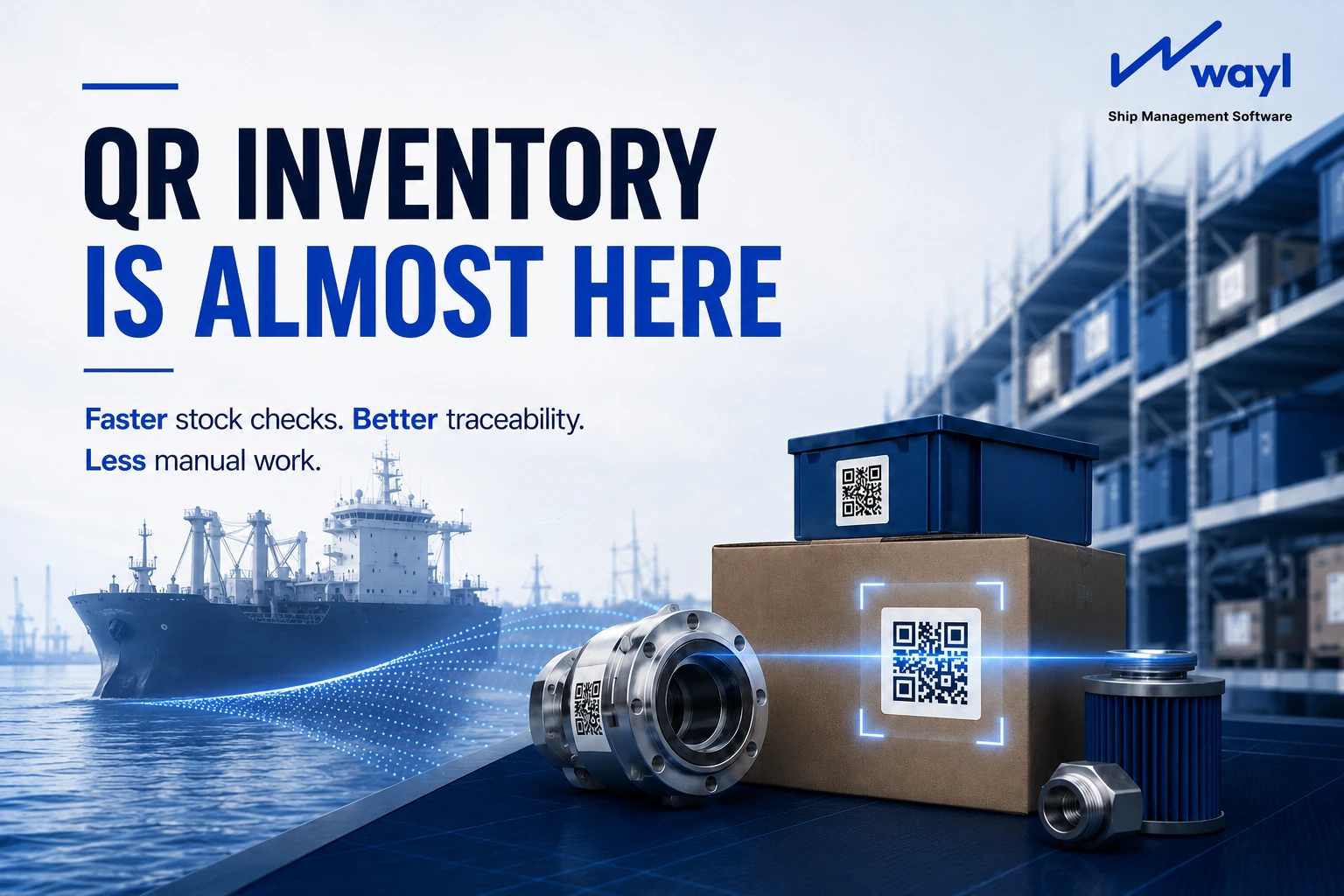
Manual inventory checks remain one of the most time-consuming and error-prone activities onboard a vessel.
Crew members must locate spare parts, confirm quantities, compare physical stock with system records, document discrepancies and report corrections to the office. When this process depends heavily on manual entry, spreadsheets or handwritten notes, even a small mistake can affect purchasing decisions, maintenance planning and operational readiness.
That is why WAYL is developing a new QR-based inventory verification workflow designed to make onboard stocktaking faster, clearer and more reliable.
The purpose of QR-based inventory is not simply to replace typing with scanning.
The real objective is to create a controlled workflow connecting physical stock onboard with the digital records available to the vessel and office teams.
The planned process will allow vessels to:
WAYL already centralizes stock records, consumption, ordering, categorisation and inventory history. Change logging and the Stock Journal provide visibility into stock activity, while direct consumption and ordering support faster operational decisions. The QR workflow will extend this control into the physical inventory-checking process onboard.
Traditional inventory checks may require the crew to search manually for each item and then locate the corresponding record in the system.
With QR-based verification, the item can be identified immediately. This reduces repetitive data entry and allows the crew to move through storerooms, workshops and technical spaces more efficiently.
Manual data entry creates opportunities for duplicated records, incorrect quantities and overlooked items.
A structured scanning process helps ensure that the physical item being checked corresponds to the correct digital record. Any difference between the registered quantity and the quantity found onboard can then be clearly highlighted for review.
Effective inventory management requires more than knowing the current quantity.
Ship managers also need to understand:
WAYL’s existing Stock Module records inventory activity, consumption and user actions. QR-based verification will strengthen this traceability by connecting physical stock checks directly with the system’s inventory history.
Incorrect stock records can lead to two costly outcomes: ordering items that are already onboard or discovering too late that a critical spare part is missing.
More accurate inventory information gives procurement teams a stronger basis for reviewing vessel requests, preparing orders and confirming deliveries. WAYL’s Purchase Module already connects vessel orders, delivery confirmation and order documentation; QR verification is intended to improve the quality of the stock information supporting those processes.
Inventory discrepancies should not disappear into emails or spreadsheets.
After a stock check, scanned information can be synchronised with WAYL, compared with the registered stock balance and presented for review. The responsible person can then approve the correction or investigate the discrepancy before the system record is changed.
This creates a clearer division of responsibility:
The vessel verifies the physical stock.
The system identifies differences.
The responsible person reviews and approves corrections.
Reliable internet access cannot always be assumed onboard.
The planned inventory workflow therefore supports offline operation, allowing inventory sessions to continue without a constant connection. Information can be stored locally and synchronised when connectivity becomes available.
This follows WAYL’s existing approach to onboard continuity, where operational data can be captured offline and synchronised with the office later.
The result is a practical workflow designed around vessel operations—not one that depends on uninterrupted internet access.
The longer-term development direction goes beyond stocktaking.
The same QR-based logic is planned to support maintenance execution inside the WAYL PMS Module. During a maintenance job, crew members could identify the relevant equipment, register the spare parts used and connect stock consumption directly to the completed task.
WAYL already supports inventory integration within PMS, including the automatic updating of stock levels when parts are consumed. QR functionality can make that connection more practical and accurate during the physical execution of maintenance onboard.
The future workflow is clear:
Open the maintenance job → identify the equipment → register the spare parts used → complete the job → update the stock record.
This creates a direct link between maintenance history and actual inventory movements.
QR-based inventory verification is not about adding unnecessary technology onboard.
It is about solving practical daily problems:
Development is moving closer to making this workflow available within WAYL.
The aim is simple:
Scan. Verify. Synchronise. Approve.
A clearer inventory process for the crew.
More reliable information for the office.
Better control across the fleet.
Would QR-based inventory verification improve stock control across your vessels?
This isn’t another software to manage. It’s your command center for smarter maritime operations.