
Сертифицировано 
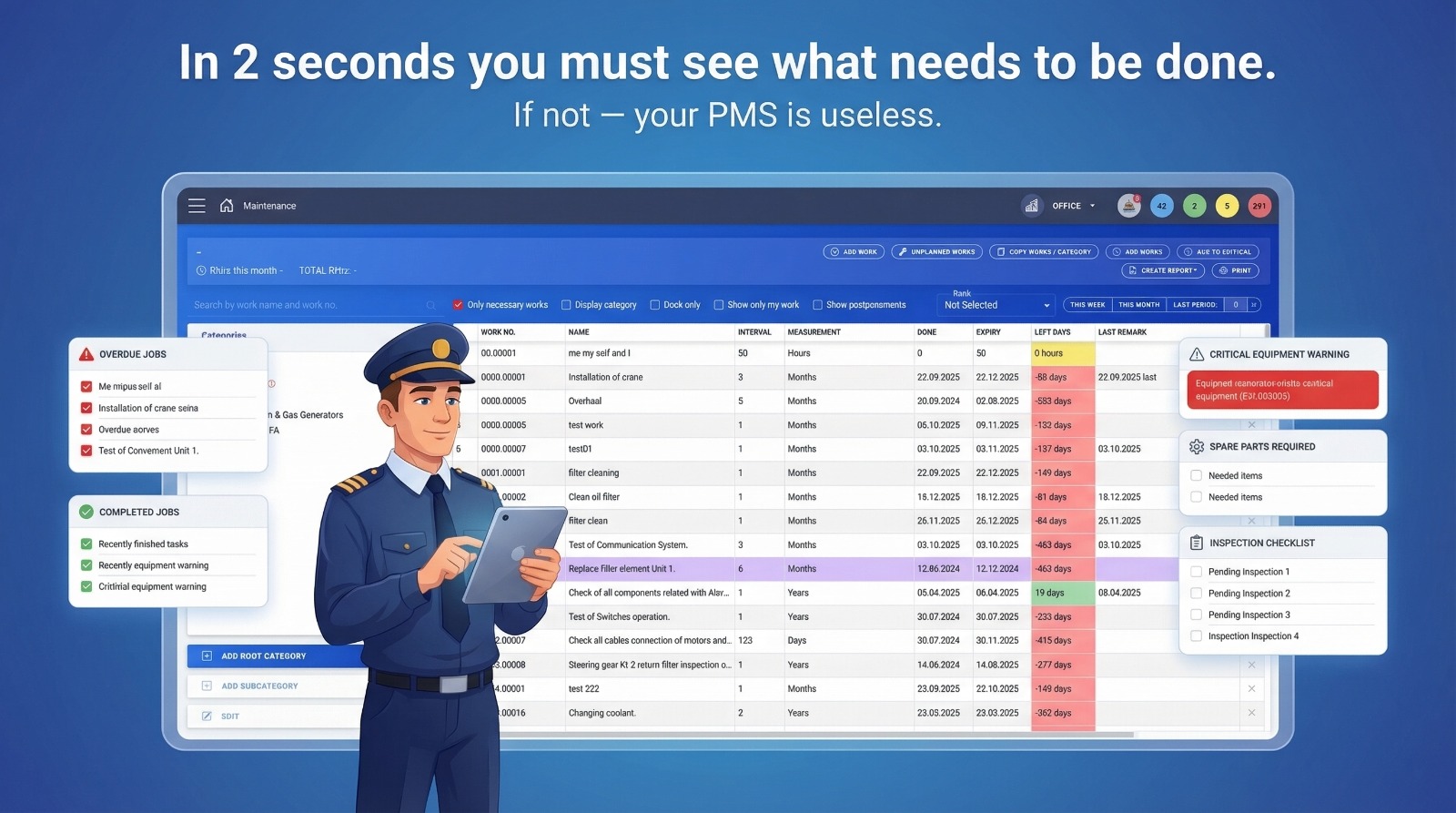
Let’s be honest.
Many ship management companies say they have a PMS.
But in reality, what they often have is only a database full of jobs that nobody clearly sees, understands, or prioritizes.
When a Chief Engineer opens the system, he should not scroll, search, or guess.
He should immediately see:
If the system cannot show this in seconds,
maintenance becomes paperwork instead of control.
A real Planned Maintenance System should not only store tasks.
It should drive decisions and actions.
In modern ship management, PMS software must help both the vessel and the office stay in control at all times.
A properly designed maintenance system should include:
Without these features, the system exists, but maintenance is still done manually.
In many companies, maintenance software becomes just another place where jobs are stored.
Crew still writes notes on paper.
Office still sends reminders by email.
Parts are ordered manually.
Overdue jobs are noticed too late.
Audits become stressful.
This happens when the system is not designed for real ship management workflow.
A maintenance system must show priorities instantly, not hide them behind menus.
A properly designed Planned Maintenance System allows the company to:
Modern ship management software automates scheduling, notifications, and task control instead of relying on manual tracking.
When maintenance is organized correctly,
you don’t manage jobs,
you manage the fleet.
Today, leading shipowners and managers use integrated fleet management systems where PMS is connected with:
This allows the company to see the real condition of the fleet in real time and make decisions faster.
Because in ship management, speed is control.
And control starts with seeing the right information in seconds.
Это не просто ещё одно программное обеспечение для управления. Это ваш центр управления для более умных и эффективных морских операций.